Comparative Analysis of DoE and SED Approaches for Enhanced Biomass Production Using the BioLector XT Microbioreactor: A Case Study
Published: अक्तूबर 20, 2026
Pasquale Mattaliano, Head of Data Science1; Eelco Meerdink, Application Scientist1; Jonas Bermeitinger, CEO1; Celine Maass, Senior Field Application Specialist2; Anna Kress, Manager Applications Science1
1LABMaiTE GmbH, 2Beckman Coulter Life Sciences
Key Takeaways
- Compare Design of Experiments (DoE) with LABMaiTE’s Smart Experiment Design (SED) for microbial media optimization using the BioLector XT Microbioreactor.
- See how both methods used results from the same initial screening to propose a second set of 48 cultivation conditions.
- Learn how SED identified a condition with 1,758 a.u. maximum backscatter, a 79% increase over the best initial-screening result.
- Review how the best SED condition produced 36% higher maximum backscatter than the best DoE condition.
- Explore how SED adjusted the media-component ranges in response to experimental results to identify productive conditions outside the ranges tested by DoE.
Introduction
With the growing industrial demand for microbial production, there is an increasing need for rapid and efficient bioprocess development. High-throughput screening of media compositions represents a key element to fill this need. The availability of advanced high-throughput cultivation systems, such as the BioLector XT Microbioreactor, has significantly enhanced the capability to perform rapid and parallelized media screening. However, this has also driven substantial interest in data-efficient, algorithm-driven optimization methods to streamline process development. Traditional methods like Design of Experiments (DoE) perform well in well-defined search spaces, but often assume relatively simple underlying response models (e.g., linear or quadratic) and rely on fixed, static experimental designs that are inefficient for iterative learning and adaptation, limiting their suitability for complex bioprocess optimization.
To address these challenges, this application note presents an optimization method better suited to the industry's need to rapidly identify optimal conditions. This case study shows a direct comparison between a conventional DoE methodology and an innovative data-efficient optimization strategy implemented by LABMaiTE GmbH, Smart Experiment Design (SED). Both approaches were applied to a two-step, iterative media optimization workflow using the BioLector XT Microbioreactor. By benchmarking these methods on a state-of-the-art microfermentation system, this case study assesses their relative effectiveness in enhancing biomass production and provides actionable insights for researchers seeking efficient process optimization strategies.
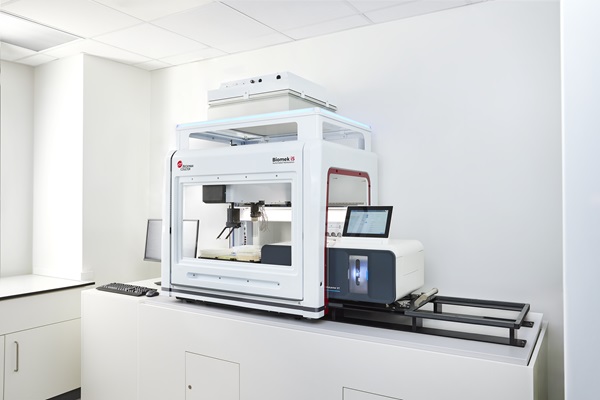
Figure 1. BioLector XT Microbioreactor & Biomek i5 liquid handler integration.
Experimental Setup
The experiments were designed to replicate the methodology presented in a recent publication (Lapierre et al., 2025) and were performed by the Beckman Coulter Life Sciences team using the latest BioLector XT Microbioreactor. To maintain alignment with the previous work, only the basic operational features of the BioLector XT Microbioreactor were utilized. While this system supports advanced process control features such as O₂ and CO₂ regulation, pH and dissolved oxygen (DO) monitoring, temperature control, pH control, and dual-line feeding through microfluidic microtiter plates, these capabilities were not used in the current batch-mode experiments. Only the temperature, shaking speed, and humidity were set and controlled during these experiments, and atmospheric air was applied at a rate of 30 mL/min.
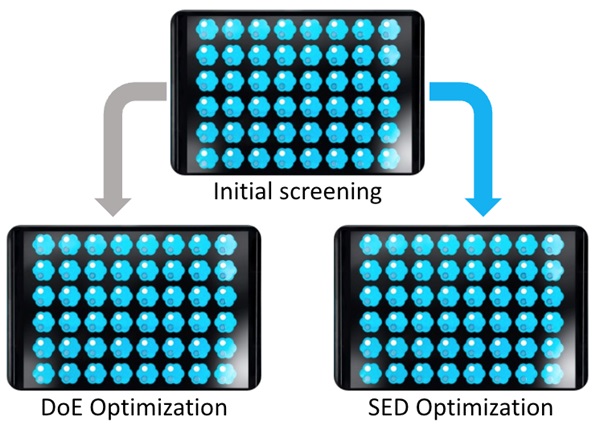
Figure 2. Illustration of the comparison procedure. Both methods share results from an initial screening, followed by one optimization round with individual proposals.
The experiments were performed using Sporosarcina pasteurii in batch format without O₂ up-regulation. The media components (factors) that varied in the experimental design included yeast extract, glucose, phosphate, trace elements, iron, vitamins, and two mixtures of amino acids, while urea was maintained at a fixed concentration (see Table 1).
| Factor name | DoE Min (µL) | DoE Max (µL) | SED Min (µL) | SED Max (µL) |
| Yeast | 85 | 331 | 85 | 482 |
| Glucose | 20 | 121 | 20 | 227 |
| Phosphate | 20 | 60 | 5 | 83 |
| Trace | 6 | 130 | 0 | 100 |
| Iron | 11 | 129 | 11 | 119 |
| Vitamins | 20 | 60 | 0 | 64 |
| Amino acids 1 | 20 | 60 | 0 | 60 |
| Amino acids 2 | 20 | 60 | 0 | 101 |
| Urea | 40 | 40 | 40 | 40 |
| Inoculum | 25 | 25 | 25 | 25 |
Table 1. Lower and upper bounds in µL per optimization method used. Composition and concentration of stock solutions are available upon request.
This application note presents a comparison between the classical Design of Experiments (DoE) approach and the Smart Experiment Design (SED) approach. The DoE method applies classical experimental design techniques to select an appropriate design type based on the specified parameters. Optimization conditions for the DoE method are defined by adjusting the minimum and maximum volumes for all factors, informed by an initial experiment analyzed with Response Surface Methodology (RSM). Using these refined parameters, the optimization proceeds with a central composite design (CCD). In contrast, the SED approach leverages an adaptive Batch Bayesian Optimization (BBO) methodology to identify high-value candidates within the search space. These conditions are derived by balancing exploration and exploitation to provide the most promising candidates, which in this case aim for higher biomass yields (Lapierre et al., 2025).
The comparison experiments followed a two-step workflow: First, an initial screening experiment was conducted, and the results served as input to both the DoE optimization and the SED optimization, thus both methods started with identical inputs. Each method was then used to generate an additional set of new combinations (including replicates for quality assurance) with the goal of maximizing biomass production.
The Biomek i5 liquid handler was used to add the individual media components into the microtiter plate (MTP) in the BioLector XT Microbioreactor. All individual components were placed on the deck in 15 mL conical tubes. All cultivations were carried out in 48-well flower-shaped microtiter plates (M2P-MTP-48-BOH1) under the following conditions: 800 µL filling volume, temperature 30 °C, mixing speed 1500 rpm and with humidity control. Media mixtures for each condition were precisely prepared using the Biomek i5 liquid handler, ensuring consistency and reproducibility across experiments.
Results
Biomass accumulation was quantified via backscatter measurements at a wavelength of 620 nm. Figure 3 summarizes the distribution of backscatter values for the initial experimental design, the SED iteration, and the DoE iteration. Each dataset represents measurements from 48 culture wells, with experimental conditions determined by either SED or DoE.
When these types of optimizations are performed, one is primarily focused on identifying the single best-performing condition, not necessarily to maximize the average across all conditions. For this reason, we only focus on the best-performing conditions in each experiment in this application note. The DoE approach produced a maximum of 1291 a.u., a 32% improvement over the initial maximum (981 a.u.). In contrast, the SED approach identified a condition yielding 1758 a.u., corresponding to a 79% improvement over the initial maximum, the highest biomass accumulation achieved in the study. This shows that SED outperformed classical DoE by 36%.
When examining the final allowed concentration ranges for media components in the DoE and SED experiments (Table 1), it becomes evident that the maximum values explored in the SED experiments are higher than those in the DoE approach. Model analysis confirmed that this broader range in the SED runs contributed substantially to the observed increases in biomass (backscatter).
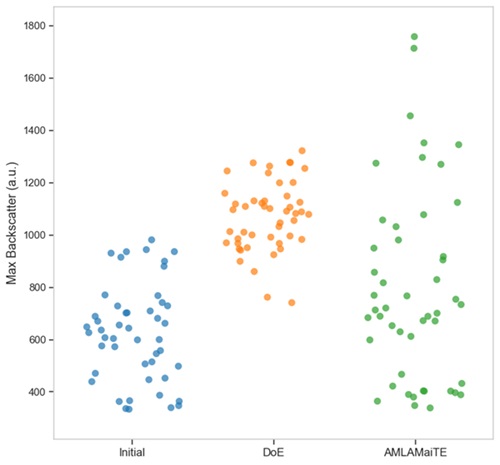
Figure 3. Maximum backscatter achieved after 48 h per tested condition. The shared initial screening is depicted in blue while the optimization results are shown in orange and green respectively. The SED candidates show a much larger spread than the DoE candidates, revealing the missed optimization potential by the DoE method.
While this difference might initially appear to create an uneven comparison, it underscores a distinct advantage of the proprietary optimization process implemented by LABMaiTE. Unlike classical DoE, which relies on manually setting factor ranges, the SED method enables adaptive, data-driven extension of range limits in response to experimental outcomes. This allows for exploration of a more tailored and potentially more productive design space, resulting in conditions that may be inaccessible or missed using traditional approaches.
These results highlight the strength of the SED approach in rapidly locating high-yield conditions compared to classical DoE.
Conclusion
This case study compares a classical DoE approach with LABMaiTE’s proprietary SED strategy for media optimization in Sporosarcina pasteurii cultivations in the BioLector XT Microbioreactor. In the setup of these experiments, SED outperformed DoE, discovering a formulation that achieved the highest biomass accumulation of the entire study, an 79% increase over the best result from the initial experiment and a 36% increase over DoE.
These results highlight that while DoE does improve experimental outcomes, SED offers a compelling advantage over classical DoE. By efficiently navigating the design space, expanding the search space in a data-driven manner, and balancing exploration and exploitation, SED can reveal high-yield conditions that may be overlooked by more traditional approaches.
Importantly, the bioprocess examined in this application note represents a typical case commonly encountered in industrial and academic settings. As such, the SED optimization strategy is likely to be broadly applicable for the development and optimization of diverse bioprocesses.
In conclusion, this application note demonstrates that the SED optimization strategy outperforms a classical DoE method, and it holds substantial potential for advancing the field of bioprocess development.
Acknowledgements
We thank Prof. Dr. Robert Huber, Prof. Dr. Frédéric Lapierre, and the University of Applied Sciences in Munich for supporting the team with their expertise, providing materials and preparing the classical DoE suggestions.
References
Lapierre, Frédéric M., et al. “Multi-cycle high-throughput growth media optimization using batch Bayesian optimization.” Journal of Chemical Technology and Biotechnology, 2025, https://doi.org/10.1002/jctb.7860.
FAQ on Biomass Production and the BioLector XT Microbioreactor
What is Bayesian optimization?
Bayesian optimization is a machine learning-based optimization technique that identifies the most promising experimental conditions by learning from previous results. It uses predictive models to estimate performance across a design space and recommends the next experiments most likely to achieve an objective, such as maximizing biomass production.
Why use a microbioreactor for high-throughput media screening?
Microbioreactors enable parallel cultivation of multiple conditions in a controlled environment, allowing researchers to rapidly compare media formulations and process parameters while reducing development time and resource consumption.
What is the best method for microbial media optimization?
Traditional Design of Experiments (DoE) methods are widely used for media optimization, but adaptive approaches such as Batch Bayesian Optimization can identify optimal conditions more efficiently by learning from experimental results and exploring new regions of the design space.
How can biomass yield be improved in microbial cultivation?
Biomass yield can be improved by optimizing key process variables such as media composition, nutrient concentrations, cultivation conditions, and feeding strategies. High-throughput screening and data-driven optimization approaches can help identify combinations of factors that maximize cell growth and biomass production more efficiently than traditional trial-and-error methods. In this study, media optimization strategies were used to identify conditions that significantly increased biomass accumulation.
How does Bayesian optimization improve bioprocess development?
Bayesian optimization improves bioprocess development by reducing the number of experiments needed to find optimal conditions. By continuously incorporating new experimental data, it efficiently guides media optimization, process parameter selection, and strain development efforts, helping researchers achieve higher yields in less time.
What is the difference between DoE and Smart Experiment Design (SED)?
DoE relies on predefined experimental ranges and static designs, while Smart Experiment Design (SED) uses adaptive, data-driven optimization to expand and refine the search space based on experimental results. This can improve the discovery of high-performing conditions for biomass production.